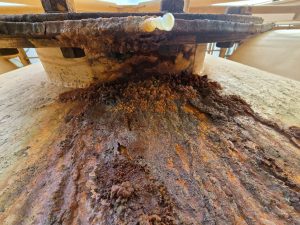


For most of its history, asset integrity has been framed as a safety and cost discipline: keep the plant running, keep people safe, avoid unplanned failures. Over the next decade, a second framing is becoming just as important: sustainability. The reason is simple: building new assets is carbon-intensive and expensive, so keeping existing assets safely in service for longer is one of the most effective decarbonisation levers available to asset-intensive industries such as mining, oil and gas, water, infrastructure and marine.
At the same time, the tools of integrity management, namely sensors, data and predictive models, are exactly the tools needed to cut waste and report on climate risk. This post looks ahead at where sustainable practices in asset integrity are heading, and offers five grounded predictions for the coming years, along with what Asset Owners can start doing now.
What Do We Mean by Sustainable Asset Integrity?
Sustainable asset integrity is the practice of managing assets so they deliver the longest safe, productive life for the least environmental cost. It connects two ideas that used to sit in separate focus areas: keeping assets fit for service; and reducing an organisation’s environmental footprint.
The link between them is embodied carbon, the emissions locked into an asset when it is built. Each tonne of steel releases on the order of 1.9 tonnes of CO₂ on average (Worldsteel), and cement production accounts for roughly 8% of global CO₂ emissions. For heavy infrastructure, much of the whole-life carbon is spent before the asset ever operates. That drastically reframes integrity work: every year of safe life extended on an existing asset is a year the carbon spike of demolition and rebuild is avoided. Managing integrity well is, increasingly, a sustainability decision.
Prediction 1: Life Extension Will Be Recognised as a Decarbonisation Strategy
Life extension has always been justified on cost. Over the coming decade, it will increasingly be justified on carbon as well. Because the embodied emissions of steel and concrete are so high, safely extending the life of an existing structure, pipeline or vessel avoids the emissions of replacing it. The 2024 revision of the ISO 55000 asset-management standards reflects this shift, folding sustainability and circular-economy thinking into the core principles of asset management. Expect avoided embodied carbon to start appearing alongside deferred capital as a formal benefit of integrity programs.
Prediction 2: Digital Twins, Predictive Analytics and Remote Inspection Will Cut Both Waste and Emissions
Condition-based and predictive maintenance are displacing fixed-calendar maintenance, and the sustainability dividend is significant. McKinsey has reported that predictive maintenance typically reduces machine downtime by 30–50% and extends equipment life by 20–40%. Every avoided failure and every extended life avoids material and emissions. Remote and robotic inspection compounds the effect: studies have found drone-based inspection can cut inspection-related CO2 by around 50%, and replacing helicopter power-line inspection with drones has saved hundreds of tonnes of CO2 a year for a single utility.
Digital Twins will become Context Twins. Context twins are virtual models fed by live condition data, and are forecast by market analysts to grow quickly through 2030. Their real value here is doing more integrity assurance with fewer physical interventions, and continuous corrosion sensing is part of the same shift from calendar-based to evidence-based inspection.
Prediction 3: Existing Assets Will Be Repurposed and Requalified Across Industries
The energy transition does not only mean new assets; it means reusing the ones we already have, and the pattern reaches well beyond oil and gas. In the energy sector, DNV forecasts that more than 50% of hydrogen pipelines globally will be repurposed natural-gas lines, up to 80% in some regions, at a cost of just 10–35% of new construction, while carbon capture and storage drives similar demand for integrity-managed CO2 transport, with the IEA projecting large growth in capture and storage capacity by 2030.
The same thinking is spreading across industries: offshore oil and gas platforms and subsea infrastructure assessed for reuse as offshore wind or CCS hubs; water pipelines, reservoirs and treatment assets kept in service rather than replaced; mining process plant, tanks and tailings infrastructure re-rated for new ore bodies or new duties; and bridges, wharves and buildings life-extended instead of demolished.
Repurposing is inherently sustainable because it reuses embodied carbon rather than spending it again, but it changes the rules an asset was designed and inspected against. A new duty can bring different loads, pressures, temperatures, fluids, or contaminants, and with them degradation mechanisms the original integrity plan never accounted for, from new corrosion and cracking mechanisms through fatigue to, in the case of hydrogen, embrittlement. Defects that were tolerable under the original service can become critical under the new one. Expect requalification and fitness-for-service assessment of existing assets, backed by service-specific integrity standards, to become a major stream of engineering work across every asset-intensive industry.
Prediction 4: Coatings and Corrosion Control Will Get Measurably Greener
Corrosion protection is quietly becoming a sustainability discipline. Low-VOC and zero-VOC coatings, below 50 g/L and 5 g/L respectively, are replacing solvent-heavy systems, and long-life coating technologies can extend recoat intervals dramatically; some fluoropolymer topcoats are rated for 30 to 60 years without repainting, against the two or three repaint cycles a conventional system would need in the same period. Fewer recoats means less material, less waste, and fewer emissions across an asset’s life. Alongside this, renewable-powered cathodic protection and bio-based corrosion inhibitors are moving from niche to mainstream. The theme is consistent: protect the asset for longer, with less environmental cost per year of protection.
Prediction 5: Integrity Data Will Become Sustainability-Reporting Data
Perhaps the biggest shift is in reporting. In 2023, the ISSB issued IFRS S2 Climate-related Disclosures, consolidating the earlier TCFD recommendations, and it requires companies to disclose the physical-climate exposure of their assets across short, medium, and long horizons. That is a question integrity teams already answer every day: what condition are the assets in, what is their remaining life, and how resilient are they? Over the next few years, the inspection, condition-monitoring, and remaining-life data held in integrity systems will increasingly feed directly into corporate climate and sustainability disclosures. Integrity data, in other words, could become audited business data.
What Operators Can Do Now
- Treat life extension as a carbon decision as well as a cost one, and start recording the emissions avoided by keeping assets in service.
- Prioritise condition-based over calendar-based maintenance where you can; it reduces both unnecessary intervention and unnecessary emissions.
- Make integrity data clean and structured now; it could soon be feeding sustainability reporting, not just maintenance planning.
- If you are repurposing an asset or changing its duty, plan the integrity requalification early, because the degradation mechanisms under the new service can differ from those the asset was originally designed for.
The next decade of asset integrity will be defined by a single realisation: the most sustainable asset is usually the one you already own, kept safely in service. Life extension, predictive and remote inspection, repurposing and requalifying existing assets, greener coatings, and integrity data flowing into climate disclosure are not separate trends; they are facets of the same shift, in which integrity management becomes a core part of how organisations decarbonise. Operators who build clean data, condition-based decision-making, and independent technical judgement into their integrity programs now will be best placed to meet both their safety obligations and their sustainability commitments.
Thinking about how to extend asset life, move from calendar-based to evidence-based inspection, or prepare your integrity data for sustainability reporting? TECHT works with asset-intensive operators to do exactly that.
Call 08 6383 9870, or email info@techt.com.au to discuss how we could work with you on what an asset integrity and condition-monitoring strategy built around your assets would look like.
Sources
- Embodied carbon of cement (~8% of global CO2) and steel (~7–9%; 1.5–3 t CO2 per tonne): IEA; SEI/UNIDO Industrial Analytics Platform; Nature, “Cement and steel — nine steps to net zero” (2022); World Economic Forum (2024).
- ISO 55000 / 55001:2024 (asset management; sustainability and circular economy): iso.org.
- Predictive maintenance downtime −30–50%, life +20–40%: McKinsey & Company, “Manufacturing: Analytics unleashes productivity and profitability.”
- Drone inspection CO2 reductions (~50%; helicopter-to-drone savings): OnePetro/ADIP; AirPixels; Airpelago.
- Digital-twin market growth forecasts (attributed to market analysts): MarketsandMarkets; Data Bridge Market Research.
- Hydrogen pipeline repurposing (>50%, up to 80%; 10–35% of new-build cost) and hydrogen embrittlement: DNV, “Repurposing onshore pipelines for hydrogen”; DNV H2Pipe JIP. dnv.com.
- CCS capture and storage growth to 2030: IEA, “CCUS projects around the world are reaching new milestones.” iea.org.
- Low-VOC and long-life coatings: AMPP ProtectPerform, “Sustainable Corrosion Protection”; PCI Magazine, “Long-Life Coatings.”
- IFRS S2 Climate-related Disclosures (2023), consolidating TCFD: IFRS Foundation. ifrs.org.